Showing posts with label world. Show all posts

We're Losing the Fight Against Corruption, Here's Why

 Up until the mid 2010s, the general trend around the world was that corruption had started to decline somewhat, which led many to assume that it would soon become a thing of the past. In spite of the fact that this is the case, a general decline in law and order that has been going on since 2016 has led to corruption making a comeback, and it might even get far worse than might have been the case otherwise.


With all of that having been said and now out of the way, it is important to note that 23 countries have seen their corruption levels become the worst they’ve ever been in the past 30 years or so. This data is coming out of Transparency International, and it also points to a rise in authoritarianism all around the world. However, it bears mentioning that democratic countries aren’t immune to this backsliding either.

The UK, Sweden, the Netherlands and Iceland are all democratic countries, but they all hit their lowest scores on the index since it first started being recorded. Even so, Netherlands remained in the top ten, as did Sweden, where they were joined by the likes of Norway, Germany, Luxembourg, Singapore and Switzerland with all things having been considered and taken into account.

On the other end of the spectrum, Somalia had the lowest score of all with 11 points out of 100. Venezuela, Syria and South Sudan were tied for second worst place with a score of 13, followed by Yemen with 16, and then North Korea, Nicaragua, Haiti and Equatorial Guinea with 17 points.

The US stood at 24th place with a score of 69, and the global average currently sits at around 43 points. This is the same average that we have seen for the past 12 years now, with two out of three countries scoring under 50 points.

A weak judicial system in countries like Poland and Hungary contributed to low scores of 54 and 42 respectively, whereas Russia saw its lowest score yet with just 26. Meanwhile, Ukraine provided some hope by continuing its 11 year growth streak with 36 points, despite Russia barging in through its door.
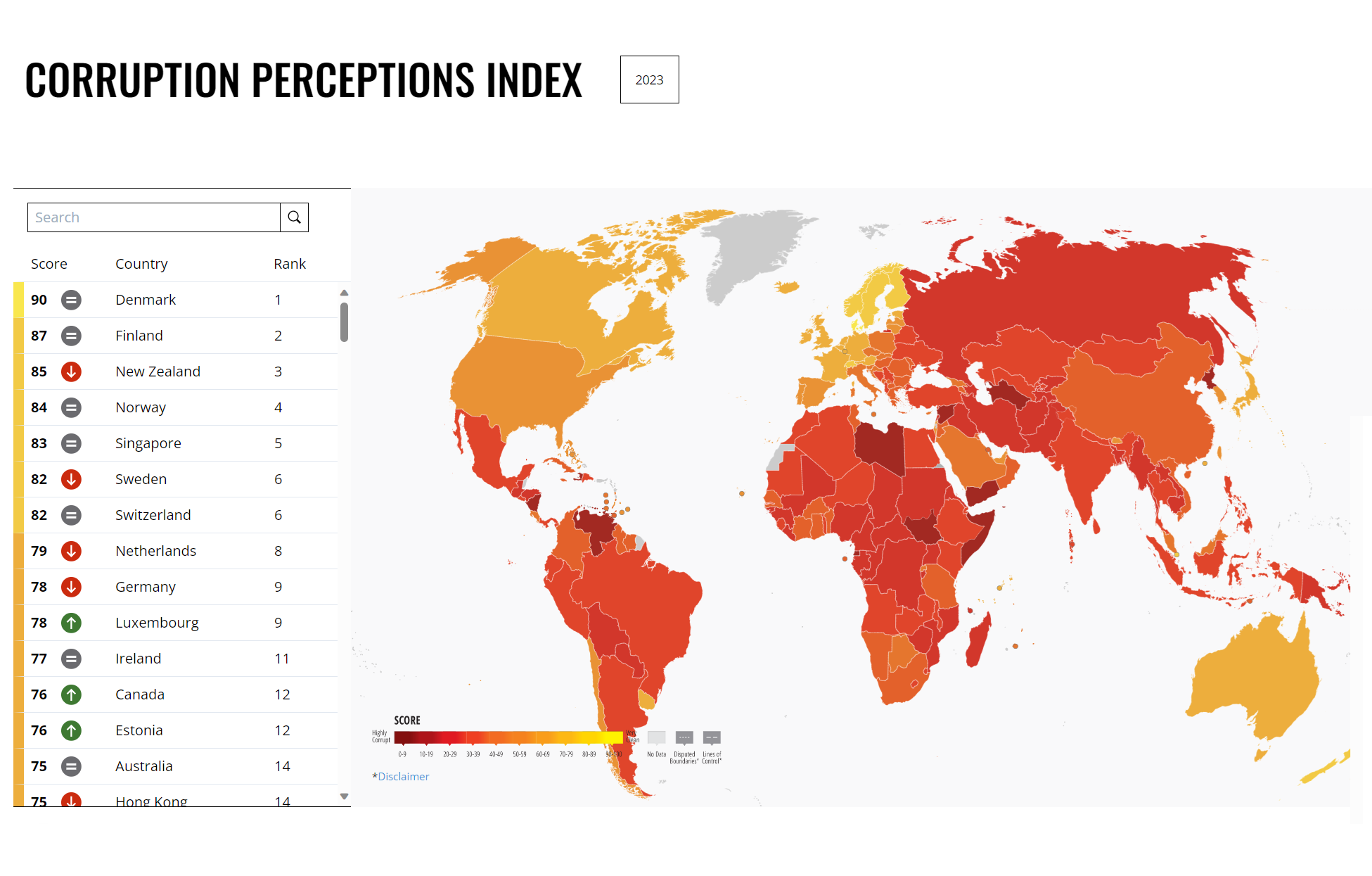
Transparency International data signals a rise in authoritarianism worldwide, affecting even traditionally democratic nations.

The UN is Afraid of Killer Robots, Here’s Why

 Thanks to the rapid advances made in the field of AI, autonomous weapons systems, or killer robots in colloquial terms, might soon become a reality. As a result of the fact that this is the case, the UN has adopted a resolution to make these systems less effective than might have been the case otherwise. These types of weapons can acquire targets without any human involvement whatsoever, which makes them an especially dangerous outcome of the current AI race.


With all of that having been said and now out of the way, it is important to note that Harvard law lecturer Bonnie Docherty recently spoke out about this issue. She described autonomous weapon systems as systems that rely on sensor inputs to determine targets rather than human input. It turns out that they have actually been used multiple times in the past, although they are not quite as sophisticated as they would eventually end up becoming.
Systems used during the ethnic conflict in the Nagorno-Karabakh region were able to identify targets all on their own. The same can be said of the systems deployed in the Libya conflict, with some referring to them as loitering munitions. These weapons can hover over the field of battle and deploy their payloads as soon as an enemy target is detected, even if a human didn’t order the strike.

Needless to say, autonomous weapon systems come with a whole host of ethical concerns with all things having been considered and taken into account. It can reduce the taking of human life to a matter of numbers and data, which many consider to be crossing a line.

Algorithmic bias is also essential to consider because of the fact that this is the sort of thing that could potentially end up discriminating against people based on their ethnicity, gender and other aspects. Even disabled individuals could end up being targeted, with the AI based targeting systems unable to discern human rights in the appropriate circumstances.
Apart from ethical considerations, legal concerns have also arisen. Machines might not be able to differentiate between military combatants and humans that are present on the battlefield in a civilian capacity. Human judgement is essential in this regard due to the reason that weighing civilian casualties against military outcomes.

This involves something called the proportionality test, wherein someone or the other determines whether or not civilian loss of life justifies military action. For all of its advancement, AI can’t yet be programmed to display human judgement.

This raises another important question that must be asked. If the AI can’t show judgement, how can it be held accountable for any potential atrocities or crimes against humanity? At the same time, the operator of the system can’t be held accountable either, since they’re not technically the one that ordered the attack.

So far, any attempts to ban autonomous weapon systems have met stiff resistance from countries like Russia. Even the US and the UK have proposed non-binding resolutions in order to leave the door open for future use of these systems should the need arise. Indeed, a number of countries prefer non-binding resolutions, with each of them coincidentally developing autonomous weapon systems of their own.

As it currently stands, the UN is trying to collect civil opinions on the matter at hand. 164 member states voted in favor of this resolution, and it will be interesting to see where things go from here on out. According to the UN Secretary General, a new treaty might be coming as early as 2026. If it fails to reach the required number of voters, the potential loss of life might be staggering. Unlike landmines and other munitions, these aren’t tried and tested weapons yet, which might make obtaining a vote harder in the long run.

a

Bill Gates Urges the Richest Countries to Donate to the Global South

 Bill Gates spoke at the World Economic Forum in Davos recently and addressed the growing divide between the Global North and the Global South. He mentioned that the resource needs of developing countries were outstripping the resources that they are capable of generating, and as a result of the fact that this is the case, they need more help from developed nations than ever before.


It is important to note that he urged the richest countries, governments, people and companies to provide aid to these struggling nations. In the 1970s, the United Nations requested economically powerful countries to donate 0.7% of the overall income the generated each year in the form of aid, and Gates referred to this while making his statements.

According to the Organization for Economic Cooperation and Development, just four countries have met this criteria, namely Norway, Sweden, Denmark and Luxembourg. If the Global South is to be saved, it’s imperative for more countries to join this list because of the fact that this is the sort of thing that could potentially end up helping fix some of the problems that are holding countries in this region back.

Gates also proposed that developing countries should be asked what their main areas of focus are, such as education, health and nutrition, or anything else that they are prioritizing at this current point in time. His final point was that more innovation was required in order to fix the many issues plaguing the Global South, such as malaria and agricultural issues.

One of his final points was that agricultural productivity needed to be optimized in order to feed growing populations. In his view, the amount of innovation in this space was orders of magnitude lower than what it should’ve been, and that might be where the first wave of innovation should go. Gates’s statements came during a panel at Davos, but it remains to be seen whether they have any type of impact whatsoever on the manner in which the wealthiest institutions distribute their wealth.


Photo: Bloomberg Live / YT