Showing posts with label cybersecurity. Show all posts

200,000 Private Records From Facebook’s User Database Stolen, Hackers Forum Confirms

 A hacker has just raised the alarm amongst Facebook users after confirming that 200,000 personal data record entries were reportedly stolen from the firm’s database.


The news is alarming for obvious reasons as the claims further went on to delineate how the cybercriminal dubbed ‘alogoatson breached contractors’ efforts that are in charge of Facebook’s cloud services. They stole part of the user database that featured a significant number of entries.

The information was rolled out by a leading threat actor dubbed ‘IntelBroker’ which is notorious for a long list of leaks that entailed data stolen through General Electric and a long list of high-profile attacks taking place.
This sample entails lists featuring full names, profile image links, and hashed passwords. Other than that, profile ratings, settings, and plenty of reviews were on display.

The hacker explained how the data that was compromised included the likes of Physical IDs.

This database was first rolled out in February and has close to 24k email IDs and a host of other compromised information. Media outlets tried to request tech giant Meta for more comments on this front but there is no response so far.

This is clearly not the first time that we’ve seen such measures take center stage where a firm like Facebook has become the center of attention in a long list of data leaks. We saw in 2022 how a database from the same tech giant featuring data records of close to 533 million users on Facebook went public online without any additional costs attached.
For a while now, the company has been slammed for enabling third parties to gather data belonging to users as was seen in the high-profile and infamous Cambridge Analytica scandal.

The danger is massive and cannot be ignored because it involves a large number of private data getting leaked that could potentially impact the lives of millions. So as you can see here, there’s a lot at stake.

So many threat actors managed to collect data for matters like phishing attacks, malicious attempts, and convincing attacks against a host of individuals where data was exposed.

Media outlets continues to update the top-of-the-line data leak checker to entail data arising from several different leaks. For this reason, warnings are generated so users continue to remain vigilant at all times and ensure top-level privacy and security with passwords that are not easy to break into.
Photo: Digital Information World - AIgen

H/T: Bleepingcomputer / Cybernews

Record Earnings for Ransomware Hackers in 2023

 In 2023, ransomware hackers made more money than ever before. They earned $1.1 billion, setting a new record. This is a big increase from the $567 million they got in 2022. Chainalysis, a company that watches blockchain activities, shared this information.


Ransomware earnings hit $1.1 billion in 2023, a record high, up from $567 million in 2022, Chainalysis reports.

The rise in earnings comes after a year when the money from ransomware dropped. But in 2023, things changed. More hackers joined in, and some big attacks brought in a lot of money. One hacking group, CL0P, made over $100 million by finding a way to break into a file-transfer service called MOVEit. This service is used by many businesses and governments. CL0P's attack on MOVEit made it the top ransomware for a while.

More people are trying ransomware because it can be very profitable. For instance, a group called Phobos lets other hackers use its ransomware. This makes it easier for more attacks to happen, even by those who are not very skilled.

Ransomware-as-a-service gangs, like LockBit and ALPHV, have made ransomware attacks go up by 68% in 2023. The US saw almost half of these attacks. The UK, Canada, Italy, and Germany also saw many attacks. The biggest ransom asked for was $80 million by the LockBit gang from Royal Mail.

The ransomware business is now worth billions. It has its own system with different roles like access brokers and software sellers. It even has things like employee of the month awards. LockBit was the biggest name in ransomware in 2023, but others are catching up.

Hackers are also finding new ways to stay hidden. They use normal tools in a way that does not look suspicious to carry out their attacks. This makes it hard to notice them. Malvertising, or harmful ads, also came back in 2023. These ads trick people into downloading malware.

Attacks on phones and computers have gotten more sophisticated. Android banking trojans were found 88,500 times. They pretend to be normal apps to steal banking details. Macs are also targeted more because they are used by many businesses.

As we moved into 2024, companies had smaller IT and security teams and budgets, making it a challenge to fight against these attacks.

Cyberattacks Are Getting More Creative, Here's What You Need to Know

 Charles Harry, an associate professor and director of the University of Maryland's Center for Governance of Technology and Systems, not to mention the former cyberwarfare expert for the NSA, has stated that cyberattacks are becoming a lot more complex. As a result of the fact that this is the case, they might come from places that you weren't expecting, which would make them a great deal more harmful than might have been the case otherwise.


According to Harry, these are the five least suspected places that a cyberattack could end up originating from:

LinkedIn

In the age of self promotion, LinkedIn has become a breeding ground for malicious actors that want to get you to click on some type of a link. They might pose as recruiters because of the fact that this is the sort of thing that could potentially end up making your more likely to fill out a form, but if you were to try to upload your resume, your system would get infected by malware.

Your favorite website

Browsing popular websites is a great way to pass the time, but you should steer clear of any tempting ads that you end up seeing while you’re there. With all of that having been said and now out of the way, it is important to note that clicking on these ads might make you fall prey to something called malvertising, so it’s best to avoid interacting with them.

Flash drives

It’s quite common to get handed a free flash drive at a convention of some sort. It bears mentioning that these drives can contain malware, which is why you should never use hardware that you got from an untrustworthy source.

Personal printers

Owning a printer can be useful, but on the off chance that you get a notification asking you to download an update, you should never ignore it. These notifications are sent by the company whenever there is a security threat, although you should make sure that the source is legitimate.

People you know

You’d never expect a loved one to scam you, which is exactly what makes deepfakes and voice cloning so dangerous. In a nutshell, a malicious actor might pose as someone you know to ask for money, or to get you to give up your account details or password.
University of Maryland professor cautions against cyber threats from seemingly harmless sources including personal printers and flash drives.

Image: Digital Information World - AIgen

Data Highlights Substantial Decrease in Ransom Payments, with Only 29% Complying in Q4 2023

 Ransomware gangs have been a prime concern for quite some time now, with victims across several industries getting targeted by their unique form of malware. Unfortunately, paying the demanded ransom isn’t really a way out because of the fact that this is the sort of thing that could potentially end up leading to re-victimization.


With all of that having been said and now out of the way, it is important to note that the proportion of people that have acquiesced to the demands of ransomware gangs has plummeted in recent years. Based on data provided by the cybersecurity company Coveware, just 29% of ransomware victims paid the demanded ransom in the fourth quarter of 2023, which indicates that 71% refused the demands with all things having been considered and taken into account.

This is a steep decline from three years ago, when a whopping 60% of companies would give the malicious actors whatever they asked for in the hopes that this would enable them to regain access to their important data. Back in the first quarter of 2019, the vast majority of companies agreed to pay the ransom, or 85% to be precise.

This seems to suggest that there has been a downward trajectory, and it might be due to companies engaging in best practices such as keeping a backup of their essential data on physical hard drives. This creates a situation wherein a ransomware attack would not actually be all that disastrous, since the data can be easily recovered even if the malicious actors wipe the infected system clean.

In spite of the fact that this is the case, some victims are still handing over extremely large funds. The average ransom payment has actually gone up even though the quantity of payments has gone down, with $408,644 paid on average in 2022, and $568,705 paid on average in Q4 2023. On top of all of that, the total quantity of ransomware attacks has been on the rise, with 3,205 instances recorded in 2023 alone. This indicates that malicious actors are undeterred by the lower proportion of payments.


NSA's Secret Web: General Nakasone Unveils Controversial Data Acquisition Tactics!


  • Gen. Nakasone reveals how NSA buys lots of Americans' internet data without permission for foreign intel and cybersecurity.
  • Netflow data shows internet traffic details, raising privacy worries for mental health and assault survivor sites.
  • Senator Wyden reveals NSA's domestic data collection, worries about agencies getting Americans' data without asking.
  • ODNI urged to make spy agencies follow rules like FTC's for legal data buying and be transparent about data keeping.
The departing chief of the U.S. National Security Agency (NSA), General Paul Nakasone, has unveiled a revelation that raises eyebrows from privacy critics — the NSA is delving into an extensive pool of commercially available web browsing data from Americans, all without the encumbrance of obtaining a warrant. This disclosure, unveiled by Senator Ron Wyden after Nakasone's correspondence, peels back the layers on the NSA's acquisition of a diverse array of information procured from data brokers, serving purposes such as foreign intelligence, cybersecurity, and secret missions.


In Nakasone's letter, he highlighted the NSA's interest in commercially available netflow data, concentrating on the intricacies of wholly domestic internet communications and interactions involving a U.S. Internet Protocol address connecting with its overseas counterpart. Netflow data, a cloak-and-dagger trove of non-content metadata, reveals the nuances of internet traffic flow, unraveling the mysteries of network activities and spotlighting servers that may be harboring the mischief of potential hackers.

Despite the NSA's discretion regarding the specific origins of the purchased internet records, Senator Wyden voiced apprehension over the sensitivity of this internet metadata. He underscored its potential to lay bare private information linked to individuals' online ventures, encompassing visits to websites dedicated to mental health, resources for survivors of sexual assault, or telehealth providers specializing in birth control or abortion medication.

Senator Wyden, entrenched in the Senate Intelligence Committee, unearthed details about the NSA's domestic internet records collection back in March 2021. However, the disclosure couldn't see the light of day until it shed its classified status. The revelation adds a layer of complexity to the ongoing scrutiny of the U.S. intelligence community's penchant for acquiring substantial datasets from private data brokers. While this practice isn't a novel concept, the ODNI's acknowledgment in June 2023 spurred concerns about its ramifications on privacy and civil liberties.

The NSA's dependence on commercially sourced data for intelligence-gathering has thrown a legal spotlight on the agency, especially as Congress scrutinizes its surveillance powers. Senator Wyden has seized upon recent actions by the Federal Trade Commission (FTC) against data brokers like X-Mode and InMarket, viewing them as significant legal milestones. These actions spotlight concerns about government agencies procuring Americans' data without explicit consent.

The NSA contends that prevailing U.S. law doesn't tether them to obtaining a court order for commercially available information. They argue that such data is equally accessible to foreign adversaries, private entities, and the U.S. government alike. Senator Wyden advocates for the ODNI to enact a policy aligning with FTC standards for legal data sales. This would compel U.S. spy agencies to purge data that doesn't meet these standards, or if retention is imperative, inform Congress or the public.

While the NSA affirms its collection of commercially available internet netflow data, the ambiguity persists on whether the agency also dips into location databases, a practice observed in other federal government agencies. Nakasone clarified in his letter that the NSA refrains from acquiring and using location data from phones or vehicles known to be within the United States, leaving room for interpretation concerning the acquisition of commercially available data originating from non-U.S. devices. The NSA, when probed, declined to expound on Nakasone's statements.

Note: Content is generated using AI and editing by humans. Photo: DIW - AIGen

Apple Registers Early Win in Battle Against Pegasus Spyware Maker.

 The story of Apple’s lawsuit against the NSO Group, which is the name of the organization that created the notorious Pegasus spyware, has just seen its first victory in favor of the tech juggernaut. The group had been trying to get the lawsuit brought to Israel, its home country, but in spite of the fact that this is the case, a judge refused to dismiss the lawsuit, which makes it so that the legal proceedings will occur on Apple’s turf with all things having been considered and taken into account.


According to the statement put out by Judge Donato, Apple will end up experiencing similar challenges to the NSO Group if the lawsuit was sent to the Israeli justice system, and the overall burden will be more or less the same. With all of that having been said and now out of the way, it is important to note that witnesses and evidence are going to be equally available regardless of the country in which the case is tried, and NSO wasn’t able to provide any reasonable factors that would make an American trial seem unfair to them.

NSO also tried to say that Apple doesn’t have sufficient grounds for a lawsuit, but Donato pointed to both the Computer Fraud and Abuse Act as well as the Unfair Competition Law in California to show that the case does have merits. As a result, the motion to dismiss was denied outright, and NSO will need to respond to the complaint by February 14th, 2024 at the latest.

This is a win for Apple because of the fact that this is the sort of thing that could potentially end up validating its claims, and Donato’s clear displeasure at NSO’s attempts to escape justice are essential to bear in mind. Apple is continuing to fight against these so-called 21st century mercenary groups through features like Lockdown Mode, along with sending users a notification in the event that state actors try to gain access to their devices. The results of this case will have widespread implications for the industry in general.


X Users Are Being Bombarded With Risky Ads Including Crypto, Phishing Scams And AI ‘Undressing’ Apps

 It appears that tech entrepreneur Elon Musk’s war against advertisers across X might be taking a new turn with some unintended consequences.


Think along the lines of users complaining about the website being bombarded with poor-standard ads including those marketing questionable Crypto Services, Phishing and Malware Scams and ‘Undressing Apps’ through AI.

Today, a team member of DIW discovered a shady ad in the home feed that leads to an obvious phishing site. Despite the ad/post being reported through X tools, as it clearly violated the platform's guidelines, it is still live. Unfortunately, there's no quick/easy way of alerting X that a post poses a security threat to its users, as there's no distinct reporting category for phishing or cybersecurity issues. DIW reached out to Twitter for a comment but has not received any reply.


On the other hand, social media users and researchers have their say on this front including how the quality of such paid promotions across X keeps going from bad to worse and it’s a direct result of top advertisers exiting the app.

In the past few weeks, the figures have reached a new high and many called out the platform for the growing figures linked to these ads and how some people included community notes as promotions to help others steer clear of the act and risk losing a huge sum of funds.

Others feel these ads were increasing by the day and to now see it on the website too is just a lot. Such see them rising on their respective timelines and others saw the surge of apps calling for ‘undressing’ and that’s leaving a very disturbing feeling in their minds.
Through AI, these platforms enable users to produce pictures of real people in a naked stance. That is a clear violation of the platform’s own terms of service that inhibits all kinds of explicit imagery and behavior from being promoted through the platform. They are rapidly spreading through the web and as per experts from top social media analysis company Graphika, such tools could be wreaking havoc in terms of being used for the likes of sextortion and targeted campaigns linked to harassment of others.

Through AI, these platforms enable users to produce pictures of real people in a naked stance. That is a clear violation of the platform’s own terms of service that inhibits all kinds of explicit imagery and behavior from being promoted through the platform. They are rapidly spreading through the web and as per experts from top social media analysis company Graphika, such tools could be wreaking havoc in terms of being used for the likes of sextortion and targeted campaigns linked to harassment of others.
For now, X has yet to generate any kind of comments linked to the ordeal that some refer to as shocking and dangerous.
The rise in such questionable content online through X is not very uncommon because other tech giants have been dealing with similar behavior and therefore gone as far as sending out apologies for the scam ads linked to the world of crypto.

Both advertisers and social media experts are telling the world that what we’re seeing happen on X is due to the large exodus of top advertisers leaving the app so that is why the firm is relying on smaller-scale advertisers to make money and that includes ad buyers that are less reputable in the industry.

One expert from an advertising agency called Mekanism spoke to a media outlet and mentioned how seeing such ads was clear evidence that big advertisers were gone and how X has gone to the bottom of the list of trying to make money and people happy.

The race is yet to be over but the behavior of X in handling this ordeal is concerning. Last month, critics reported witnessing ads that market things like stealing semen that kept on being promoted on the app, and the fact that suspicious ads keep increasing is just a lot to accept.

We think the biggest issues linked to X have to do with all large-scale advertisers walking out and the frequency arising reaching an all-time high. This really does give rise to a tough time for advertisers and users who are genuine fans of the platform.

By this behavior, it’s quite clear that X has zero desire to produce an environment that promotes brand safety. Seeing the likes of Apple and Disney amongst other leaders leaving the app due to Musk promoting anti-Semitic posts is proof of the challenges that X keeps on facing as we speak. Instead of sitting down and talking to them, he chose to tell them to f**k themselves and referred to the act as terrible blackmail.

Meta’s Instagram Is Full Of Fake Profiles That Are Catfishing Users But The Company Could Care Less

 Seeing scammers and imposters arise on social media is now a norm in the online world.


But you’d expect tech giants like Meta to do more to help safeguard its users online by getting rid of fake profiles. However, the reality seems to be far from that as many noticed the number of fake profiles surging across the Instagram app.

In the past year, we’ve seen the issue go from bad to worse and the app’s parent firm is really falling behind in terms of finding a solution to the matter, despite there being many signs that a certain profile is making use of another’s identity or image.
An investigation was also carried out by tech media outlet Bleeping Computer on this front and they noticed how a large number of reports were filed against such scam accounts featuring fake IDs and they were impersonating internet personalities or other public figures but ended up getting dismissed by the admin. Clearly, it’s a huge issue and no appeal made a difference, not to mention how the profiles continue to function on the app as we speak.

Conceptual image created with AIgen

After seeing all of this, it would not be wrong to mention that Instagram has transformed into a giant safe haven where scammers are working at large. People are interacting with others based on what they appear like on the outside or what their profile says, only to find out later on that it’s all a scam and nothing is real.

their profile says, only to find out later on that it’s all a scam and nothing is real.

Authenticity on social media is rare as it is and now that fake profiles are going unnoticed by Meta’s Instagram we’re seeing a major issue arise here. To pretend like you are someone other than your true identity is concerning and a major sign of catfishing. Anyone can produce two identities for several reasons. One of the main ones is to separate their real or personal endeavors from their professional world. But you need to be honest at least, right?

A growing number of users are speaking about how they keep on generating complaints on this front and seeing Meta dismiss them and leave those fake ID accounts as it is has them wondering what’s going on and if any safeguards were really in place. All they give as a part of the justification is linked to how they are following Community Guidelines and using both human and tech for reviewing purposes. And yes, no appeals work either so what is a person supposed to do, right?

When leading media outlets ask Meta to shed light on what’s going on, they are yet to hear back from any of the company’s reps. And that again is another red flag worth a mention.

Could this be the latest ploy from the tech giant in terms of selling blue ticks?

We don’t think such acts are a mere coincidence. They are becoming far too normal on the platform and something needs to be done before it’s too late.

Plenty of imposters seem to be targeting real profiles of leading public figures, influencers, law enforcement officers, and creators involved in producing adult content. They then start following the followers located on the actual account. And their hope is to attain followers back to ensure they are getting the tag of being authentic. They then block the profile that they are copying and this ensures no contact is made with the real user in question.


Those who are suffering are the real ones who fear their identities are being used for catfishing purposes and they cannot do anything about it because Meta takes on a silent stance. So what could the reason be?

Well, the news is that Meta is forcing users to purchase blue ticks to try and ensure they attain greater protection perhaps they wish to increase their user numbers by not labeling these kinds of content as spam or a fake profile.

Today, the subscription is priced between $12 to $15 and it’s not cheap to get Meta Verified, not to mention an added business for the company with these staggering monthly earnings.

MFA is Powerless Against This Vicious New Hacking Tool

 Countless security protocols have been put into place in order to stave off potential cyberattacks, but in spite of the fact that this is the case hackers, malicious actors and cybercriminals only keep upping the ante. This has resulted in a cyber arms race, with cybersecurity professionals often playing catchup with the aforementioned malicious actors once all has been said and is now out of the way.


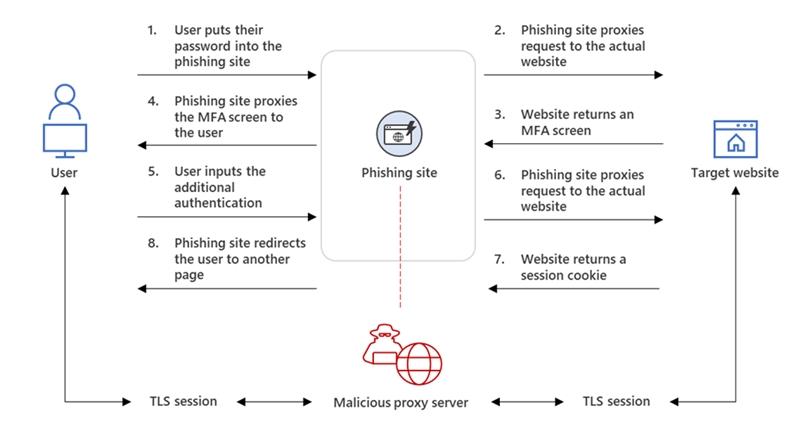
With all of that having been said and now out of the way, it is important to note that a brand new hacking tool has just been noted which might topple the current cybersecurity infrastructure that so many rely on to keep themselves safe online. This tool is called EvilProxy, and it can potentially steal authentication tokens used for MFA on websites with all things having been considered and taken into account.

The most concerning thing about this hacking tool is how easy it is to use because of the fact that this is the sort of thing that could potentially end up turning inexperienced newbie hackers into seasoned professionals who can pose a major threat. A cybersecurity research firm by the name of Resecurity is first discovered this hacking tool which was going by the name of Moloch at that time. They found it widely available on the dark web as PaaS platform which stands for Phishing as a Service.


This hacking tool can significantly improve the efficacy of phishing attacks. It works by taking you to a legitimate login page, one that would not contain any of the red flags that may have made users aware that their information is about to be stolen. The hacking tool then redirects the information that is put in, and that can result in even the most cautious of users having their log in data end up in the wrong hands.

Cybercrime is turning into an industry in its own right, and cybersecurity researchers will have to figure out a way to get ahead of the curve. Until that happens, the risks that are found on the internet will continue to multiply and become more pronounced.