Ding! There’s your phone again, telling you another message just came through. We’ve all been guilty of taking a look at a new notification and thinking, “I’ll get to that later.” Then later turns to hours or days, and that text from mom or email from a coworker is still unanswered.
Maybe you were busy or just didn’t feel like replying—but a new study by Secure Data Recovery suggests there might be something more going on. Almost half of Americans report that the notification bubble or bell makes them feel overwhelmed. If your phone is stressing you out, it might be easier to put it face down on the table and let it buzz than try to sift through all your new messages.
So, is ignoring our messages a valid way to cope in an often too-fast-paced world? Or are we just hurting our friends’ feelings when we leave them “on read”? Secure Data Recovery’s study answers these questions and more, and this post offers some insight into people’s habits with this practice as well as how it impacts their lives.
How unread messages impact relationships
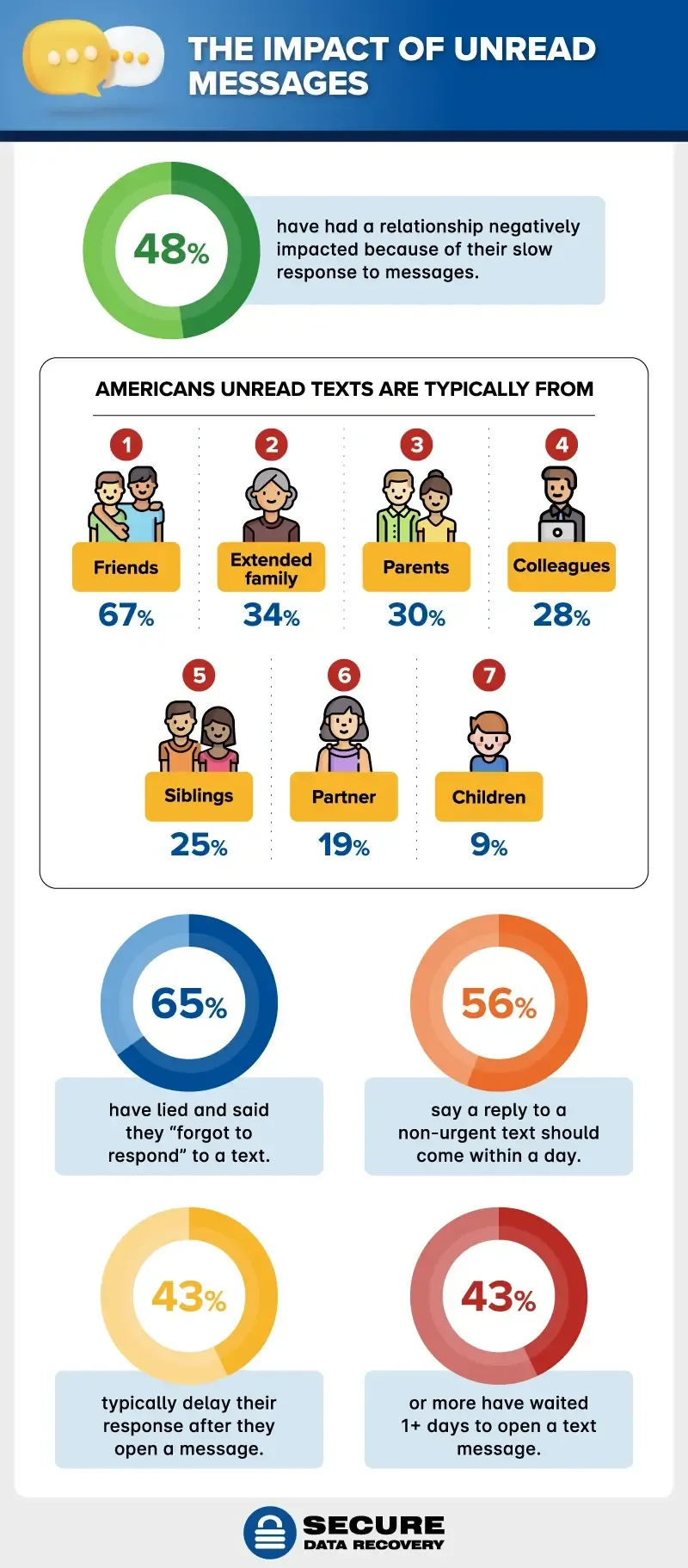
Despite living in the age of hyper-connectivity, almost 57% of Americans have a backlog of unread messages. And your phone’s storage space isn’t the only victim of the pileup—almost half of us have had a relationship negatively impacted by our slow response time.Unread messages have broken friendships (43%), dampened romances (31%), and even hurt our prospects at work (25%). While that might seem a little blown out of proportion, your buddy, partner, or project lead just might not appreciate being as low on your priority list as that unread promotional email from three weeks ago.
Funny enough, 92% of us consider ourselves to be low-maintenance friends, meaning we don’t expect things like regular check-ins, calls, or face-to-face interactions. Maybe it’s a tacit acknowledgment of our own bad communication habits. Who are we to demand timely replies if we can’t even answer texts ourselves? Looks like, even in an increasingly digital world, we’re still getting the hang of this instant communication thing.
Responding too quickly shows obvious desperation (uncool), but responding too late might earn you an honorary spot in the “bad friend” category (also uncool). Most of America has found a sweet spot: About 56% of us agree that a response to non-urgent texts should come within a day.
America’s message response habits
So, you finally opened that message. Now comes the hard part—actually writing back.Responding too quickly shows obvious desperation (uncool), but responding too late might earn you an honorary spot in the “bad friend” category (also uncool). Most of America has found a sweet spot: About 56% of us agree that a response to non-urgent texts should come within a day.
Of course, not everybody sticks to this unspoken rule. Dwelling among us are the 43% of champion procrastinators who have comfortably waited over 24 hours to open a text. Another 43% are the masters of suspense, taking their sweet time to respond once they’ve read the message. Text is at least a little less egregious than email, where 63% of us have waited a week or more to check the inbox.
We’ve gotten so good at this game that 65% of us have pulled out the classic, “I forgot to respond” excuse. Yeah, right. Does anyone ever believe that line? And yet, we somehow still manage to spend over 11 minutes a day on average dealing with text messages. Maybe deciding whether or not to open them eats up some time.
Of all the states in our great nation, people in California, Kentucky, and West Virginia have the most unread texts, with averages of 5.6, 5.2, and 4.9, respectively. Compare that to people in Maine, Arizona, and Alabama, who only leave, on average, 2.2, 2.39, and 2.78 messages unread.
But Alabamanians aren’t perfect. They might read their text messages, but they lead the pack in holding onto unread emails, with a whopping 13.10 in their inboxes on average. Massachusetts and Maryland aren’t far behind, leaving 12.25 and 11.6 emails unanswered. If you want your email answered, send it to someone in Washington (5.2), New York (6.2), or Virginia (6.5), where the average number of unread messages is nearly cut in half.

 An incessantly buzzing phone is the last thing you need at the end of a stressful day. Having the ability to instantly connect to anyone at any time, anywhere is great and all, but, on the other hand, it can also make us feel bound to our phones—sometimes we just want to rage against the pocket-sized machine.
While there’s no shame in leaving your messages unread, try to remember that they’re not just designed to annoy you, at least not always. Usually, someone you care about is on the other end of the line, waiting for your reply.
We’ve gotten so good at this game that 65% of us have pulled out the classic, “I forgot to respond” excuse. Yeah, right. Does anyone ever believe that line? And yet, we somehow still manage to spend over 11 minutes a day on average dealing with text messages. Maybe deciding whether or not to open them eats up some time.
Where Americans are the worst at opening messages
America, land of the free—and land of a lot of unread messages, apparently. Though text message procrastinators can be anywhere, some states have worse communication habits than others.Of all the states in our great nation, people in California, Kentucky, and West Virginia have the most unread texts, with averages of 5.6, 5.2, and 4.9, respectively. Compare that to people in Maine, Arizona, and Alabama, who only leave, on average, 2.2, 2.39, and 2.78 messages unread.
But Alabamanians aren’t perfect. They might read their text messages, but they lead the pack in holding onto unread emails, with a whopping 13.10 in their inboxes on average. Massachusetts and Maryland aren’t far behind, leaving 12.25 and 11.6 emails unanswered. If you want your email answered, send it to someone in Washington (5.2), New York (6.2), or Virginia (6.5), where the average number of unread messages is nearly cut in half.


Final Thoughts
While there’s no shame in leaving your messages unread, try to remember that they’re not just designed to annoy you, at least not always. Usually, someone you care about is on the other end of the line, waiting for your reply.
So, before you contemplate hurling your phone to the far reaches of your room, pause a moment, and remind yourself of the human connection each ping represents—it might just make tackling that dreaded inbox a little easier.


